PBICT News
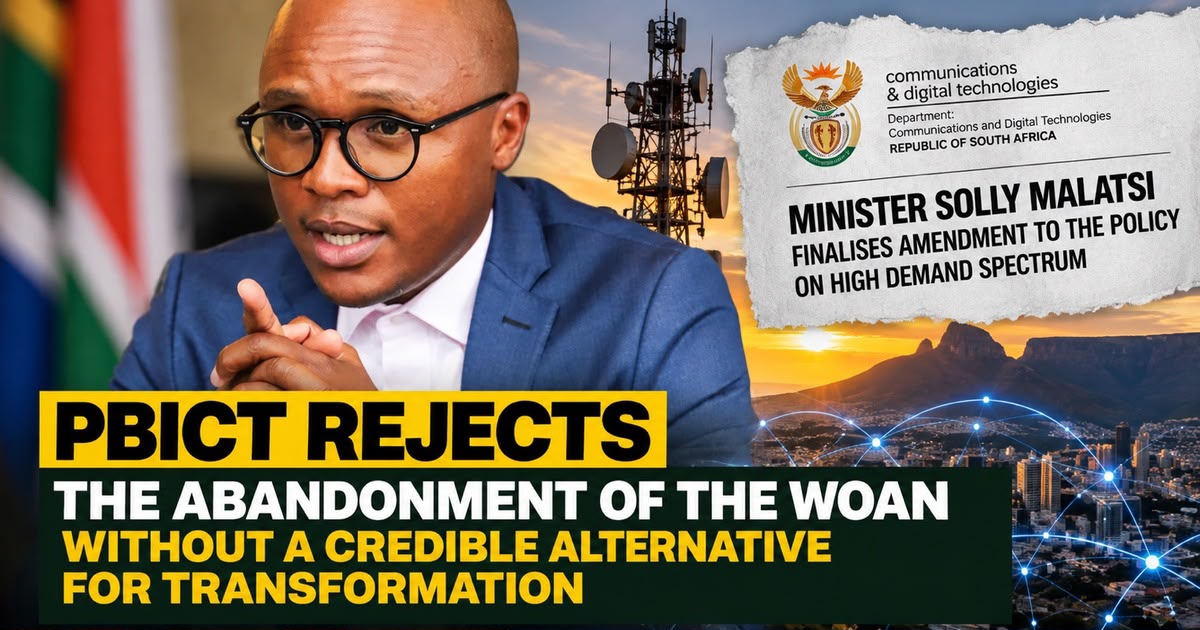
PBICT Rejects the Abandonment of the WOAN Without a Credible Alternative for Transformation
PBICT REJECTS THE ABANDONMENT OF THE WOAN WITHOUT A CREDIBLE ALTERNATIVE FOR TRANSFORMATION29 September 2026 The Progressive Blacks in Information and Communication Technology (PBICT) notes with serious concern the decisi
PBICT REJECTS THE ABANDONMENT OF THE WOAN WITHOUT A CREDIBLE ALTERNATIVE FOR TRANSFORMATION
29 September 2026
The Progressive Blacks in Information and Communication Technology (PBICT) notes with serious concern the decision by the Minister of Communications and Digital Technologies, Hon. Solly Malatsi, to withdraw the reservation of high-demand spectrum previously intended for the Wireless Open Access Network (WOAN), together with the policy direction under which ICASA was directed to license such a network. The spectrum concerned will now become available for licensing by ICASA.
PBICT accepts that radio-frequency spectrum is a scarce national resource and cannot remain indefinitely unused. The Department correctly notes that more than seven years have passed without the WOAN being licensed and that the spectrum identified for this purpose has remained substantially unassigned. However, the failure to implement a policy instrument should not be confused with the failure of the policy objectives that gave rise to it.
The WOAN must be understood within the historical development of South Africa's telecommunications sector. Since the democratic transition, telecommunications policy has sought not only to expand connectivity and attract investment, but also to address universal access, competition and the structural exclusion of historically disadvantaged South Africans from meaningful ownership and participation in the sector. The WOAN emerged from this policy trajectory as an attempt to lower barriers to entry by creating shared wholesale infrastructure through which new and emerging operators could participate without first having to replicate the capital-intensive national infrastructure accumulated by established operators.
A successful WOAN could have materially altered the economics of market entry. A black-owned ECNS licensee in Mthatha, Giyani, Mahikeng or Mbombela could, in principle, have acquired wholesale capacity on transparent terms and concentrated its capital on connecting communities, developing services and competing for customers rather than attempting to construct an entire national mobile network. The broader opportunity was to create an ecosystem of black-owned ISPs, regional operators, MVNOs and telecommunications enterprises participating in network engineering, fibre deployment, tower infrastructure, software, cybersecurity and other components of the digital value chain.
This is why PBICT believes that the abandonment of the WOAN cannot simply conclude with the release of its spectrum. The Department itself confirms that the amended policy retains wholesale-access obligations, universal-service obligations in rural and underserved areas, measures against concentration of spectrum and empowerment requirements. The critical question is whether these mechanisms will be sufficiently measurable and enforceable to achieve meaningful structural transformation.
As South Africa enters an economy increasingly shaped by artificial intelligence, cloud computing, data centres, 5G, satellite communications and digital public infrastructure, the question of who owns and participates in the country's digital infrastructure becomes even more important. South Africa cannot build an inclusive digital economy in which the historically excluded majority participates predominantly as consumers while remaining marginal to the ownership of productive digital infrastructure.
PBICT therefore calls for the development of a National Spectrum and Telecommunications Transformation Framework, involving government, ICASA, industry, black ICT organisations, SMMEs, organised business, labour and academia. Such a framework should establish measurable interventions for emerging operators, wholesale access, infrastructure sharing, rural and regional networks, black-owned ECNS and ECS licensees, local procurement, access to finance and meaningful participation by women, young people and persons with disabilities.
PBICT further calls for a substantive review of why the WOAN failed to progress from policy conception to implementation. The country must understand whether the constraints were institutional, regulatory, commercial or administrative so that these lessons can inform future telecommunications policy.
PBICT does not advocate for spectrum to remain unused, nor do we oppose investment, competition or technological innovation. Our position is that efficiency and transformation cannot be treated as mutually exclusive objectives. Spectrum can and must be put to productive use while simultaneously broadening ownership, competition and meaningful economic participation.
If government has concluded that the WOAN has reached the end of its policy life, it carries a corresponding responsibility to explain what credible instrument will replace its transformation mandate.
The policy instrument may change, but South Africa's developmental imperative to transform the telecommunications sector cannot.
ENDS
Issued by:
Progressive Blacks in Information and Communication Technology (PBICT)
29 September 2026
For Media Enquiries:
Luvo Grey
Secretary General
Progressive Blacks in Information and Communication Technology (PBICT)
Tel: 076 618 0755
Email: luvog@pbict.org